Why You Stretch Every Day and Still Feel Tight
Quick Answer: Persistent tightness despite daily stretching usually means the sensation is protective rather than structural — your nervous system limiting range it does not feel it can control. The fix is strengthening through range, not more passive stretching: loaded end-range work, isometrics at the limit, and eccentric control. Most people see change in three to four weeks.
You have been consistent. That is the frustrating part.
Ten minutes every morning, the same hip stretches, the same hamstring holds, and your hamstrings feel exactly as tight as they did in March.
The reason this happens is genuinely interesting, and once you understand it the fix is fairly obvious — it just is not more of what you have been doing.

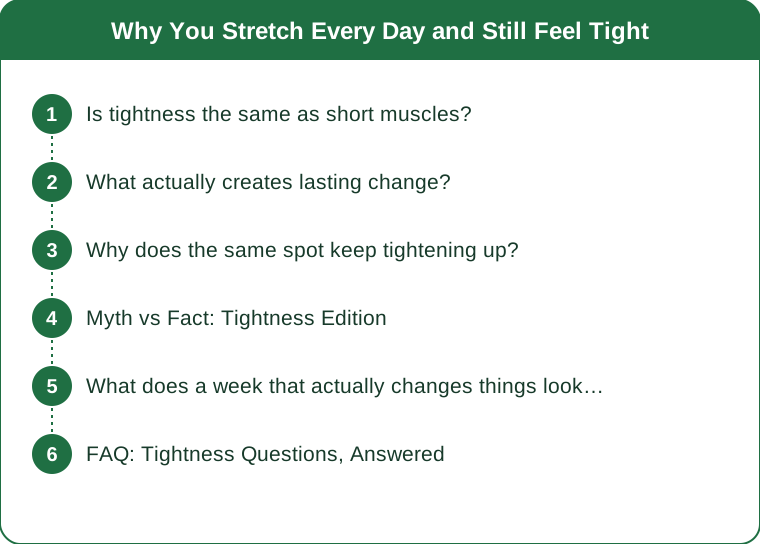
Is tightness the same as short muscles?
Usually not, and this is the crux of the whole thing.
The sensation of tightness is produced by your nervous system, not measured by your tissue. It is a protective output — a signal that says this range is not one I can control right now — and it correlates far more with perceived stability than with actual muscle length.
Evidence for this is reasonably strong. People routinely gain range within a single session, which is far too fast for tissue to lengthen. Stretching the opposite limb increases range in the untouched one. And range gains from stretching are largely explained by increased stretch tolerance rather than structural change.
A muscle can be both short and strong, long and weak, or full-length and still feel tight. Hamstrings are the classic case: many people with “tight hamstrings” have entirely normal length and a nervous system that restricts range because there is no strength to control it.
This also explains why tightness comes back within hours after stretching. You temporarily raised tolerance. You did not change what caused the guarding.
What actually creates lasting change?
Strength through the full range. This is the whole answer and it is well supported.
The principle: your nervous system permits range it can control. Build control at end range and the protective limit moves.
Three methods that work, in ascending order of effectiveness:
Loaded stretching. Hold the stretched position under load rather than passively. A dumbbell in the bottom of a split squat, a light weight in a hamstring stretch. Load teaches the nervous system that the position is manageable.
End-range isometrics. Get to your limit, then actively contract into it for 20 to 30 seconds. In a hamstring stretch, press your heel down into the floor. This is the single highest-value technique for most people and it costs no equipment.
Eccentric work through full range. Slow lowering into deep positions — Romanian deadlifts, deep split squats descending over four seconds, controlled Nordic curls. Eccentric loading produces genuine tissue adaptation alongside the neural change.
A workable structure: two to three sessions weekly, 5 to 8 minutes, on two or three positions that actually matter to you. Not a fifteen-position routine. Three positions, loaded, consistently.
Why does the same spot keep tightening up?
Because it is compensating for something adjacent that is not doing its job.
A muscle that repeatedly feels tight is often working overtime, and the tightness is fatigue-related guarding rather than a length problem.
The common patterns:
- Chronically tight hamstrings frequently accompany weak glutes. The hamstrings take over hip extension and never get a break. Stretching them makes them longer and no less overworked.
- Tight hip flexors often pair with weak deep core and an anteriorly tilted pelvis. The flexors are holding a position, not shortening spontaneously.
- Tight upper traps usually mean the lower traps and serratus are underperforming, so the upper traps carry the shoulder blade alone all day.
- Tight calves often reflect limited ankle dorsiflexion combined with weak tibialis anterior.
The tell: if it feels tight again within hours of stretching, look at what is adjacent and weak. The tight muscle is the symptom; the underworking neighbor is usually the cause.
This does not mean stretching is useless. It means stretching the loud one without strengthening the quiet one is treating the alarm rather than the fire.

Myth vs Fact: Tightness Edition
Myth: You need to hold a stretch for 60 seconds or it does nothing. Fact: For range gains, total weekly duration matters more than any single hold. Multiple 30-second holds accumulate the same benefit, and active techniques outperform passive holds regardless of duration.
Myth: Stretching before a workout prevents injury. Fact: Static stretching before activity temporarily reduces force production and has not been shown to reduce injury rates. A dynamic warm-up does both jobs better. Save static work for after or for separate sessions.
Myth: Flexible people are less injury-prone. Fact: Excessive range without control is its own risk factor. Hypermobile individuals frequently have more joint pain, not less. Controlled range beats maximum range.
Myth: Foam rolling lengthens fascia. Fact: The forces required to deform fascia are far beyond what a roller applies. Rolling works through neural mechanisms — it temporarily reduces the protective response. That is real and useful, and it is not structural change.
Myth: If it hurts, it is working. Fact: Pain during stretching increases the protective response, which is the opposite of what you want. Work at a strong sensation, not a painful one. The nervous system does not grant range to a position it reads as threatening.
What does a week that actually changes things look like?
Small, loaded, and specific to two or three positions.
Pick your two or three. Not a full-body routine. Choose the positions that limit something you actually do — a deep squat, overhead reach, hip extension for running.
Session structure, 8 minutes:
- Two minutes of general movement to warm up. Cold end-range work is where people get hurt.
- Get to your limit in position one. Hold 20 seconds passively.
- From that position, contract into it hard for 20 to 30 seconds.
- Relax and move slightly deeper. Repeat twice.
- Same for positions two and three.
Three times per week is plenty. Daily is unnecessary and, for loaded work, counterproductive.
Add loaded eccentrics twice weekly as part of your normal training: slow Romanian deadlifts, deep split squats with a four-second descent, controlled overhead work.
Expect three to four weeks before the sensation changes meaningfully. Range often improves in week one; the feeling of tightness lags behind, because tolerance and control take longer to build than acute stretch tolerance.
This is general information, not medical advice. Tightness accompanied by pain, numbness, tingling, or a specific injury needs assessment rather than a mobility routine.
FAQ: Tightness Questions, Answered
Should I stop stretching entirely?
No. Stretching increases stretch tolerance, feels good, and has value as a calming practice. Just stop expecting it to resolve chronic tightness on its own, and add the loaded end-range work that actually changes the limit.
How do I know if it is a strength issue or a genuine length restriction?
Rough test: if your passive range is noticeably larger than your active range — you can be pulled into a position you cannot get into yourself — that gap is a control problem, not a length problem. Most chronic tightness sits in that gap.
Does age change any of this?
Tissue does become somewhat stiffer with age, and recovery takes longer. The underlying principle does not change: strength through range remains the most effective intervention at every age, and it becomes more important, not less.
TL;DR:
- Tightness is largely a protective nervous-system output, not a report on muscle length.
- Range you can control is range you get to keep — build strength at end range.
- End-range isometrics and loaded eccentrics beat passive holds for lasting change.
- A muscle that keeps tightening is often covering for a weak neighbor. Look adjacent.
- Two or three positions, eight minutes, three times a week. Expect three to four weeks.
The reframe that makes this click: you are not trying to make the muscle longer. You are trying to convince your nervous system that the position is safe, and it only accepts that argument when you show up with strength.
Keep Reading
This article is for general informational purposes only and is not medical advice. Always consult a qualified health professional for guidance specific to you.