Why Does Mobility Work Land Better After Lifting Than Before?
Quick Answer: After lifting, tissue is warm, joints have moved through load, and there is no working set left to compromise. Stretching before a session can temporarily reduce force output and is competing with a warm-up you actually need — after it, the same work costs nothing and lands on tissue that is far more receptive.
Most people do this backwards, and it is not their fault. The stretch-first script is decades old.
The timing is doing more than the technique.
This is general information, not medical advice.

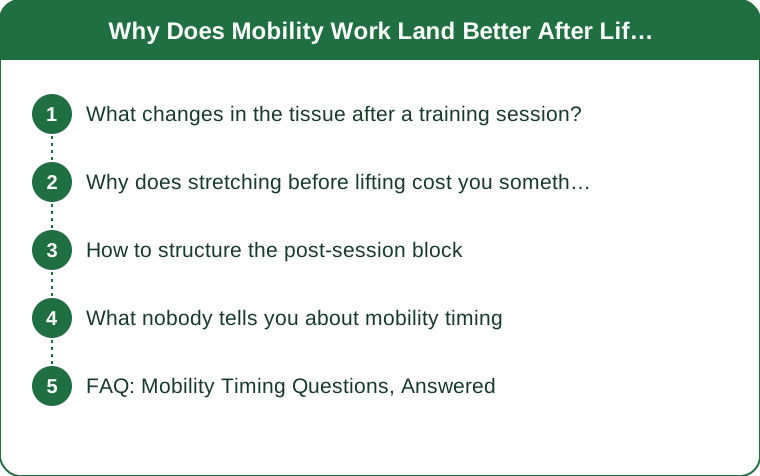
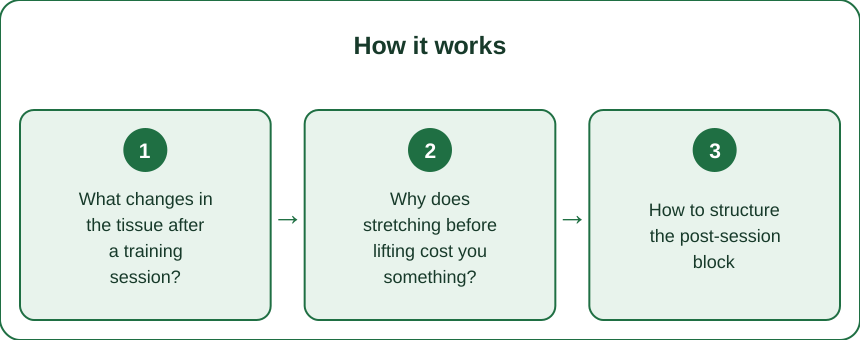
What changes in the tissue after a training session?
Three things, and all of them favor mobility work.
Temperature. Muscle and connective tissue become more compliant as they warm, and an hour of loaded movement raises tissue temperature far more than a five-minute warm-up does. More compliant tissue moves further at the same perceived intensity, which means the stretch you can access at the end is genuinely deeper than the one you could reach at the start.
Joint preparation. Loaded movement circulates synovial fluid and the joint capsule has already been taken through range repeatedly. A hip that has done three sets of squats is a hip that is ready to be taken to end range.
Neural state. Range of motion is limited by protective tension as much as by tissue length — your nervous system holds back before you reach the structural limit. That protective threshold tends to sit further out once a joint has moved under control through the same range, which is why a stretch after training often feels less guarded than the identical stretch cold.
Does this mean stretching cold is harmful?
No — cold stretching is not dangerous, it is just less productive. You get less range for the same effort, and it is less likely to stick.
Why does stretching before lifting cost you something?
Because static stretching immediately before loading has a measurable, temporary effect on force production.
The research picture is more nuanced than the headlines: long holds — generally over 60 seconds per muscle — show the clearest performance decrement, while short holds inside a broader dynamic warm-up appear to cost little or nothing. But the practical version is simple. If you have ten minutes and one session, spending it on static stretching before your heaviest set is the worst-value slot available.
There is a second cost that nobody counts. Pre-session mobility work competes with the warm-up for time, and the warm-up has a clearer job. When people cram both into the same block, the warm-up gets shortened, and a cold first working set costs more than tight hamstrings do.
The exception worth naming: specific mobility that unblocks the lift you are about to do. If restricted ankles are stopping you from reaching depth, a targeted ankle drill before squatting is not general stretching — it is preparation with a defined purpose, and it belongs there.
What should go before a session instead?
Dynamic work through the ranges you are about to load — controlled leg swings, bodyweight versions of the pattern, gradual ramping. Movement, not holding.

How to structure the post-session block
The practical version takes eight to twelve minutes and does not need a plan longer than the workout.
Pick two or three positions, not eight. Whatever felt most restricted during the session is your list. If the squats felt blocked at the bottom, hips and ankles. If pressing felt cramped overhead, thoracic spine and lats.
Hold longer than feels necessary — 60 to 120 seconds per position. Short holds are appropriate before training; after training, longer holds are where the range change happens. The first 30 seconds is usually just settling.
Add gentle contraction at end range. Pushing lightly into the stretch for five seconds, then relaxing further, is the core of contract-relax methods and generally produces more immediate range than passive holding alone. Two or three cycles per position.
Finish with one loaded rep in the new range. This is the step people skip and it is the one that makes it stick. A bodyweight squat to full depth, an overhead reach with a light plate — something that tells your nervous system the new range is usable, not just achievable.
Then leave it alone. Mobility gains fade within hours if nothing reinforces them. The reinforcement is the next session’s movement, not more stretching that evening.
What nobody tells you about mobility timing
The end-of-session slot survives because it has no competition. Mobility work scheduled as its own session is the most-skipped training block there is. Attached to the end of a workout you are already at, it happens. Adherence is not a small factor — it is most of the outcome.
Range gained after lifting is more likely to be range you can use. You just spent an hour producing force. Adding range immediately afterward, in a body that is still in a working state, is closer to how you will need to access it than a cold morning stretch is.
The post-workout stretch does not reduce soreness meaningfully. This is the reason most people do it and it is the one thing it does not reliably deliver. Stretching after training is worth doing for range, not for tomorrow’s DOMS — the evidence there has been unimpressive for years.
Cooling rooms change the window. As the weather turns, gyms and garages drop several degrees, and the tissue-temperature advantage after training fades faster than it does in July. Starting the block within a few minutes of the last set matters more in October than it did in August.
Twice a week beats seven days of two minutes. Range responds to meaningful exposure. Two proper ten-minute blocks attached to sessions you were doing anyway outperform a daily habit that never reaches the threshold.
FAQ: Mobility Timing Questions, Answered
How long do the gains from one session last?
Acute range improvements largely fade within hours. Lasting change comes from repeated exposure over weeks — commonly cited timelines run four to eight weeks for meaningful, retained range. Judge it monthly, not daily.
Should I stretch on rest days too?
You can, but warm up first — five minutes of easy movement before holding anything. A cold stretch on a rest day is the least productive version of this available.
Is foam rolling better before or after?
Before, mostly. Rolling produces short-term range improvements without the force decrement that long static holds can cause, which makes it a reasonable pre-session tool. After training it is largely a comfort measure.
What if I only stretch and never lift?
Then the warm-up becomes the whole prerequisite — ten minutes of brisk walking or general movement before your stretching block. The principle is unchanged: warm tissue takes range better than cold tissue.
Does this apply to yoga?
A yoga session is not the same as a stretching block, since it builds its own warmth through movement. The relevant point still holds: the deeper positions in a well-sequenced class come later for exactly this reason.
TL;DR:
- After lifting, tissue is warm, joints are prepared, and there is no working set left to compromise.
- Long static holds before training can temporarily reduce force output and steal warm-up time.
- Post-session: two or three positions, 60 to 120 second holds, contract-relax cycles, then one loaded rep in the new range.
- Stretching does not reliably reduce soreness — do it for range, not for tomorrow.
- Two attached ten-minute blocks per week beat a daily habit that never reaches threshold.
The cheapest improvement available here is not a better stretch. It is the same stretch, moved forty minutes later.
This is general information, not medical advice.
Keep Reading
This article is for general informational purposes only and is not medical advice. Always consult a qualified health professional for guidance specific to you.