How Long Should You Actually Hold a Stretch
Quick Answer: For lasting flexibility gains, weekly total time under stretch matters more than the length of any single hold. Reviews suggest that accumulating roughly five minutes per muscle group per week produces meaningful range of motion improvements, and how you slice that up matters much less than hitting the total. Thirty to sixty second holds are a practical default. Very long holds are not necessary, and very short ones are only a problem if the weekly total is too low.
Thirty seconds is the number everyone knows. It came from a small number of studies in the 1990s comparing hold durations, and it has been repeated ever since as if it were a physical constant.
It is a reasonable default. It is not the variable that decides whether stretching works.

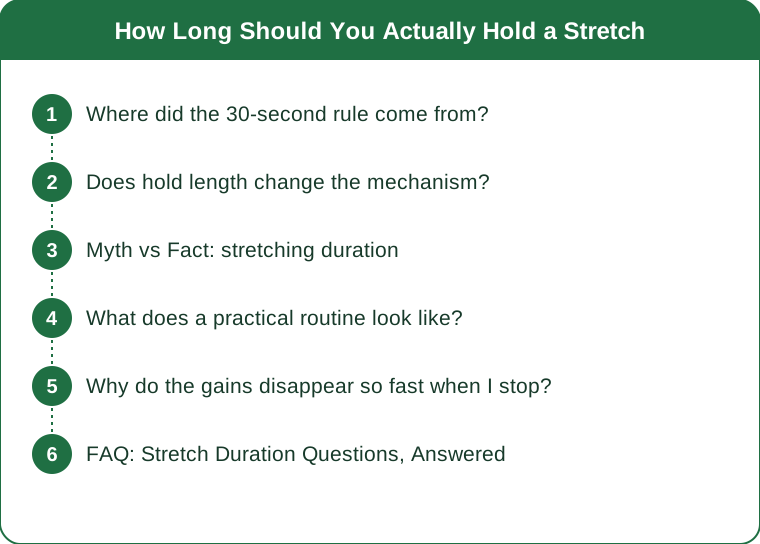
Where did the 30-second rule come from?
From a genuinely useful set of studies, applied more broadly than they should have been.
In the 1990s several papers compared static stretch holds of different durations, commonly 15, 30 and 60 seconds, over several weeks. They generally found that 30 seconds produced more improvement than 15, and that 60 did not clearly beat 30.
That is a fine finding. What happened next is that it hardened into a rule, and the rule quietly implied that duration per hold was the key variable.
Subsequent research points somewhere else. Total weekly volume under stretch appears to be the stronger predictor. A 2023 systematic review examining stretching volume concluded that accumulated time is what drives range of motion change, with roughly five minutes per muscle group per week emerging as a useful threshold, and diminishing returns beyond that.
So two minutes of holds five days a week and five minutes twice a week are broadly comparable. You can distribute it however fits your life, which is a far more useful conclusion than a fixed number of seconds.
Does hold length change the mechanism?
Somewhat, and this is where short and long holds genuinely differ.
Short holds, under about 20 seconds, primarily produce a temporary reduction in the stretch reflex and a small change in tissue behaviour. Useful for warming up, not much use for lasting change.
Moderate holds, roughly 30 to 60 seconds, allow what is called stress relaxation, where the tension in the tissue drops over time at a constant length. Most of that drop happens in the first 15 to 30 seconds.
Long holds, several minutes, are the basis of approaches like yin yoga and long-duration loaded stretching. There is some evidence for greater acute range gains, and interest in whether prolonged loaded stretch drives structural adaptation, though the human evidence for that is still thin.
What actually produces lasting flexibility, in most current thinking, is largely a change in stretch tolerance rather than a change in muscle length. Your nervous system becomes willing to allow more range. That adapts to repeated exposure over weeks, which is exactly why weekly volume beats hold duration.
Myth vs Fact: stretching duration
Myth: Under 30 seconds does nothing. Fact: Shorter holds contribute to weekly volume and produce acute range increases. They are less efficient per hold, not worthless.
Myth: Longer is always better. Fact: Beyond about 60 seconds per hold, gains per additional second fall off sharply for most people. Two 45-second holds generally beat one 90-second hold on both compliance and comfort.
Myth: Stretching lengthens the muscle. Fact: In healthy adults over normal timeframes, most of the measured gain reflects increased tolerance to stretch, not added sarcomeres. This is why gains fade relatively quickly when you stop.
Myth: You should stretch to the point of pain. Fact: Mild tension, not pain. Comparisons of intensity generally find no advantage to painful stretching, and it reduces adherence considerably.
Myth: Static stretching before training ruins performance. Fact: Overstated. Meaningful performance decrements mostly appear with long holds, above roughly 60 seconds per muscle, without a subsequent active warm-up. Short holds followed by dynamic work are fine, and this has been walked back substantially from the original alarm.

What does a practical routine look like?
Built around weekly volume rather than a magic number.
- Pick the two or three areas that actually limit you. Stretching everything spreads a fixed time budget too thin to reach the threshold anywhere.
- Target roughly five minutes per area per week. That could be 60 seconds a day, or two sessions of two and a half minutes, or four 75-second holds.
- Use 30 to 60 second holds as a default because they are comfortable and easy to count.
- Stretch to mild tension, around a 4 to 6 out of 10, and breathe normally throughout.
- Consistency beats intensity. Four short sessions a week produce more than one long one, mostly through adherence.
- Combine with strength through range if you want the gains to hold. Loaded work at long muscle lengths, deep squats, Romanian deadlifts, deficit work, produces range improvements that persist better than passive stretching alone.
When during the day?
Whenever you will actually do it. There is no strong evidence for a superior time. Post-training is convenient because you are already warm, and evening works well for many people.
How long before I see change?
Measurable range improvements typically appear in three to four weeks of consistent work, with continued gains for a few months.
Why do the gains disappear so fast when I stop?
Because tolerance adaptations decay quickly, and this is one of the more useful things to understand about mobility.
Strength persists for weeks after training stops. Flexibility does not. Studies on detraining in flexibility commonly find substantial losses within two to four weeks of stopping, and near-complete reversion within a couple of months.
This is consistent with the tolerance explanation. A nervous system adaptation that exists because of repeated recent exposure fades when the exposure stops.
The practical implications are worth stating plainly.
Mobility is a maintenance activity, not a project. There is no point at which you have done it and can stop, in the way you can maintain strength on a third of your usual volume.
The maintenance dose is low though. Something in the region of one to two minutes per area, twice a week, appears sufficient to hold gains once you have them. That is a very small ongoing cost.
And loading through range is the more durable version. If you want ankle range that survives a busy month, deep squats hold it better than calf stretches do, because strength adaptations persist longer than tolerance adaptations.
This is general information, not medical advice. If a restriction is painful or came on suddenly, get it assessed.
FAQ: Stretch Duration Questions, Answered
Is PNF stretching more efficient?
Contract-relax methods do often produce larger acute gains per session. Long-term differences versus static stretching are smaller than the acute comparison suggests, and PNF is harder to do alone.
Should I stretch every day?
You can. Daily short sessions are an easy way to hit weekly volume, and there is no meaningful recovery cost to moderate stretching.
Does holding a stretch longer help if I am very tight?
Not particularly. More frequent exposure helps more than longer single holds. Very tight areas usually need weeks, not longer sessions.
Do foam rolling and stretching count toward the same total?
They are different stimuli. Foam rolling produces short-lived range increases without the same longer-term adaptation, so treat it as a warm-up tool rather than as part of the weekly stretching volume.
This is general information, not medical advice.
TL;DR:
- The 30-second rule came from a narrow set of studies and hold duration is not the main variable.
- Weekly volume is, with roughly five minutes per muscle group per week producing meaningful range gains.
- Use 30 to 60 second holds at mild tension because they are practical, not because the number is special.
- Most gain is increased stretch tolerance, which is why it fades within weeks of stopping.
- Hold gains with one to two minutes twice a week, and make them more durable by loading through range.
Stop counting seconds and start counting minutes per week. It is the same effort, distributed by what fits your schedule rather than by a number from 1994.
This is general information, not medical advice.
Keep Reading
This article is for general informational purposes only and is not medical advice. Always consult a qualified health professional for guidance specific to you.