Why Mobility Work Sometimes Doesn't Transfer to How You Actually Move
Quick Answer: Passive mobility drills improve range of motion in a controlled, isolated position, but transferring that range into functional movement (walking, lifting, sport-specific patterns) requires active strength and motor control training through that same new range — mobility work alone builds the range; strength work through that range is what actually makes it usable.
Stretching and mobility drills genuinely improved how far a joint could move on the mat. Real-world movement — walking, lifting, everyday tasks — still feels just as restricted as before. That gap is common, and it has a specific, addressable cause.

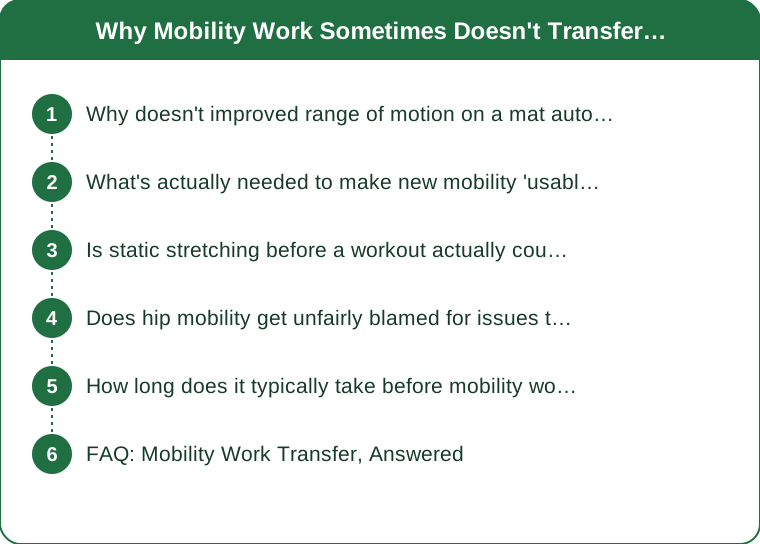
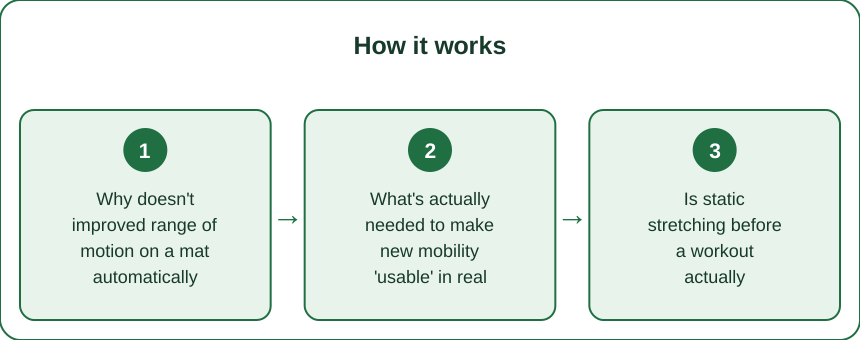
Why doesn’t improved range of motion on a mat automatically show up in daily movement?
Passive or assisted range of motion (achieved through stretching or a controlled drill) demonstrates that a joint can move through a bigger range, but it doesn’t teach the nervous system to actively control and use that new range under load or in a dynamic, less controlled context — the range exists, but it isn’t yet integrated into how you move.
What’s actually needed to make new mobility ‘usable’ in real movement?
Active strength training through the newly available range — for example, loaded exercises performed at the end range of a stretch, not just the stretch itself — teaches the nervous system to trust and control that range under real demand, which is the actual transfer step most mobility routines skip.
Is static stretching before a workout actually counterproductive here?
It can be, in a specific way — some research suggests static stretching immediately before power or strength-based activity can temporarily reduce force output and reaction speed, meaning a pre-workout static stretch routine focused purely on passive range may work against, not for, the performance and control you’re trying to build for that session.

Does hip mobility get unfairly blamed for issues that are actually ankle-related, or vice versa?
Yes, commonly — restriction that shows up at the hip during a squat, for instance, sometimes actually originates from limited ankle mobility forcing compensation further up the chain. Addressing the wrong joint based on where restriction is felt, rather than where it originates, is a common reason mobility work doesn’t transfer as expected.
How long does it typically take before mobility work starts showing up in actual movement quality?
Passive range improvements can show up within a few weeks, but genuine functional transfer — feeling that new range integrated into daily movement or sport-specific patterns — typically takes longer, often 6-8 weeks of combined mobility and strength work through the new range, since it requires real motor learning, not just tissue length change.
FAQ: Mobility Work Transfer, Answered
Should mobility work be done before or after strength training?
Dynamic mobility work (controlled, movement-based, not static holds) before training and more passive stretching after tends to support both performance and transfer better than static stretching beforehand.
Is daily mobility work necessary, or is occasional stretching enough?
Daily, brief mobility work tends to outperform occasional longer sessions for actual functional transfer, since consistency matters more than single-session duration for motor learning.
Can mobility restrictions ever be structural rather than something training can fix?
Yes — some restrictions are due to joint structure itself rather than soft tissue tightness, and no amount of stretching or strength work through that range will meaningfully change a genuinely structural limitation; a professional assessment can help distinguish the two.
TL;DR:
- Passive mobility work builds available range but doesn’t automatically teach the nervous system to use it
- Loaded strength work through the new range is the actual missing step for functional transfer
- Static stretching right before power-based training can temporarily reduce force output
- Real functional transfer typically takes 6-8 weeks of combined mobility and strength work, not just stretching alone
If mat mobility has improved but real movement still feels restricted, add loaded strength work through that new range — that’s usually the missing piece, not more stretching.
Keep Reading
This article is for general informational purposes only and is not medical advice. Always consult a qualified health professional for guidance specific to you.