Why Mobility Gains Fade After a Week Off but Strength Does Not
Quick Answer: Strength is retained far longer than range of motion because much of strength is stored in muscle tissue and neural patterns that decay slowly, while much of a mobility gain is a change in stretch tolerance, a nervous-system adaptation that reverses quickly without regular exposure. Measurable flexibility losses appear within two to four weeks of stopping, versus eight to twelve weeks for meaningful strength loss. The mobility work that survives a break is the loaded, end-range strength kind, not passive stretching.
You take ten days off. You come back and the bar still moves roughly the way it did.
Then you try to get into the bottom of a squat or reach overhead and it is as though the last three months did not happen. This is not your imagination and it is not a sign you were never actually mobile.

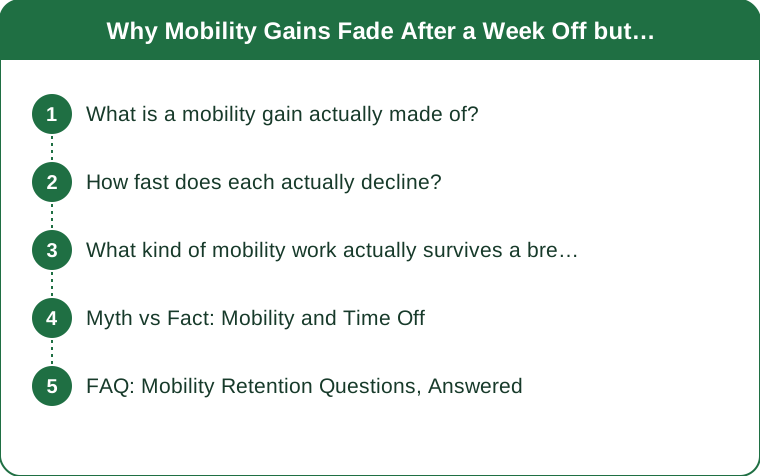
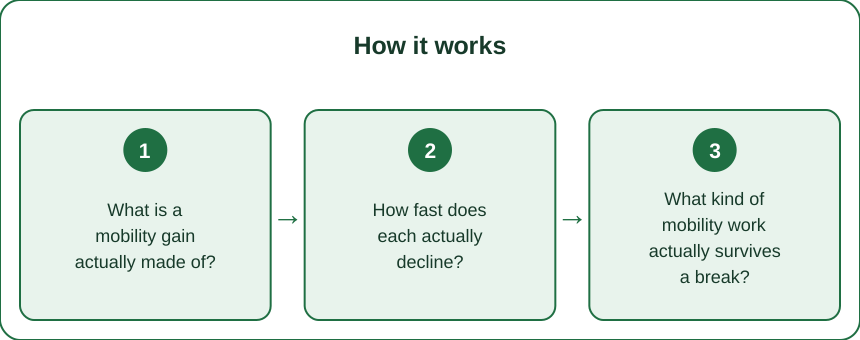
What is a mobility gain actually made of?
Three different things, and they persist for very different lengths of time.
1. Stretch tolerance, which is most of it in the short term. When you gain range in a few weeks of stretching, most of the improvement is a change in how much stretch sensation your nervous system will permit before it limits you. Studies comparing muscle length measurements before and after short-term stretching programs consistently find range increases with little or no change in actual tissue length. Your tolerance changed, not your hamstring.
2. Neural control at end range. The ability to actively produce force in a newly available position. This is a motor skill and it behaves like one.
3. Actual tissue change. Increases in muscle fascicle length and changes in connective tissue properties do occur, and they require months of consistent loading, not weeks of stretching. This is the part that lasts.
Why the proportions matter. If most of your gain is category 1, it will decay fast, because tolerance is a live nervous-system setting that resets without regular input. If you built category 3, much more survives.
The uncomfortable implication. Someone who has stretched passively for three months and someone who has trained loaded end-range positions for three months may test identically on a sit-and-reach, and one of them will still have most of it after a break and the other will not.
How fast does each actually decline?
The timelines are well documented and the gap is large.
Flexibility and range of motion:
- Measurable declines appear at two to four weeks without training
- Most short-term stretching gains are substantially reversed by four to eight weeks
- The decay is faster the faster the gain was acquired, which is the general pattern for tolerance-based adaptations
Strength:
- Maximal strength is largely maintained for two to four weeks with no training at all
- Meaningful declines begin around three to four weeks and are gradual thereafter
- Trained individuals retain strength considerably longer than newly trained ones
- Neural components, meaning coordination and rate of force development, decline before muscle size does
Muscle size:
- Measurable atrophy typically begins after about three weeks of complete inactivity
- Losses are slower than most people fear, and regaining is much faster than the original acquisition because of the persistence of myonuclei
Aerobic fitness: sits between the two, with meaningful VO2 max declines from about two weeks.
Why the difference exists. Strength has a large structural substrate that decays slowly, plus deeply grooved motor patterns. Mobility, as most people train it, rests largely on a nervous-system setting that has no structural inertia at all.
One consoling detail: re-gaining lost range is much faster than gaining it the first time. People typically return to their previous range within a fraction of the time it originally took, usually one to two weeks rather than the original three months.

What kind of mobility work actually survives a break?
Loaded work at end range, and the difference is substantial.
Why loading changes the outcome. Producing force in a lengthened position does three things passive stretching does not:
- It builds strength through the new range, so the position becomes usable rather than merely available
- It provides a mechanical stimulus for genuine tissue adaptation, including increases in fascicle length
- It builds a motor pattern, which is retained on the same timeline as other motor skills, meaning years rather than weeks
What this looks like in practice:
- Loaded stretching, such as a Romanian deadlift taken to a controlled full range, or a deep goblet squat held under load
- End-range isometrics, contracting hard in the deepest position you can control, for 10 to 30 seconds
- Full range of motion strength training, which is the least glamorous and most effective option. Squatting deep, pressing overhead fully, and rowing to full stretch does most of what a separate mobility routine does.
- Eccentric work through full range, which has the strongest evidence for increasing fascicle length
What survives badly: passive static stretching alone, held positions without contraction, and range achieved through relaxation only.
A reframing worth adopting. Range of motion you cannot control is not really yours. The gap between passive range, what someone can push you into, and active range, what you can achieve under your own control, is the part that disappears during a break. Narrowing that gap is what makes mobility durable.
Minimum effective maintenance. Research on flexibility maintenance suggests once weekly is often sufficient to hold gains, even though two to three sessions are needed to acquire them. This is the single most useful practical finding here, because one short session a week is achievable during busy periods when a full routine is not.
Myth vs Fact: Mobility and Time Off
Myth: you lost the flexibility because your muscles tightened up. Fact: muscle length changes very little over two weeks. What changed is your nervous system’s tolerance for stretch sensation. The tissue is essentially the same length and your permission threshold moved.
Myth: static stretching is useless. Fact: it reliably increases range and it is the least durable method. It is an efficient way to gain tolerance and a poor way to build something that persists. Use it, and do not expect it to survive a holiday.
Myth: you have to start over after a break. Fact: regaining lost range takes a fraction of the original time, typically one to two weeks. The underlying structural adaptations you built did not vanish, only the tolerance setting reset.
Myth: stretching more often is the answer to losing it. Fact: for retention, once weekly is usually enough. The variable that matters is the kind of work, not the frequency. A weekly loaded session retains more than daily passive stretching does.
Myth: mobility and flexibility are the same thing. Fact: flexibility is passive range. Mobility is range you can control and produce force in. Almost everything in this article is about why the second one lasts and the first does not.
What nobody tells you: sleep and stress change your range day to day. Stretch tolerance is a nervous-system output, and it responds to sleep debt, stress, and even ambient temperature. Feeling tight on a Monday after a bad night is a genuine change in tolerance, not a change in tissue, and it usually resolves without any intervention. This is worth knowing because people frequently conclude they have lost progress based on a single bad session.
A practical maintenance protocol for busy periods: one session weekly, three positions that matter for you, and in each one hold the deepest position you can control and contract hard against it for 20 seconds, twice. Total time under ten minutes. This retains far more than the equivalent time spent stretching passively.
Seasonal note: most people feel stiffer as the weather cools, and part of this is genuine, since tissue is more compliant when warm and ambient temperature affects how quickly you warm up. Lengthening your warm-up by five minutes in autumn is more useful than adding stretching, because you are addressing the actual cause.
This is general information, not medical advice. Range limited by pain, or a sudden loss of range in one joint, is worth having assessed rather than stretched.
FAQ: Mobility Retention Questions, Answered
How quickly do you lose flexibility?
Measurable declines appear within two to four weeks of stopping, and most short-term stretching gains are substantially reversed by four to eight weeks. This is considerably faster than strength, which is largely retained for the first three to four weeks.
Why does strength last longer than mobility?
Strength has a structural substrate, muscle tissue and grooved motor patterns, that decays slowly. Most short-term mobility gain is a change in nervous-system stretch tolerance, which has no structural inertia and resets quickly.
What is the minimum to maintain mobility?
Roughly once weekly is sufficient to retain range, versus two to three sessions to acquire it. Loaded end-range work retains far better than passive stretching for the same time invested.
TL;DR:
- Most short-term mobility gain is stretch tolerance, a nervous-system setting that resets within two to four weeks off.
- Strength persists because it has a structural and motor-pattern substrate that decays slowly.
- Loaded end-range work, full-range lifting, and end-range isometrics build the version of mobility that survives a break.
- Once weekly is enough to maintain. Regaining lost range takes one to two weeks, not another three months.
Swap one passive stretching session this week for the same positions held under contraction. It is the difference between renting range and owning it.
Keep Reading
This article is for general informational purposes only and is not medical advice. Always consult a qualified health professional for guidance specific to you.