Why Hips Feel Completely Locked in the Morning but Loosen Within an Hour of Waking
Quick Answer: Morning hip stiffness comes primarily from reduced synovial fluid circulation and mild inflammation buildup during hours of stillness overnight, both of which resolve naturally within the first hour or so of movement as blood flow and joint lubrication increase — a short, gentle mobility routine within the first 10-15 minutes of waking speeds up this natural process rather than just waiting for it to resolve on its own.
The locked-up feeling in the hips first thing in the morning and the noticeably looser feeling by mid-morning aren’t two different states of the same joint — they’re the predictable before-and-after of a process that happens every single night.

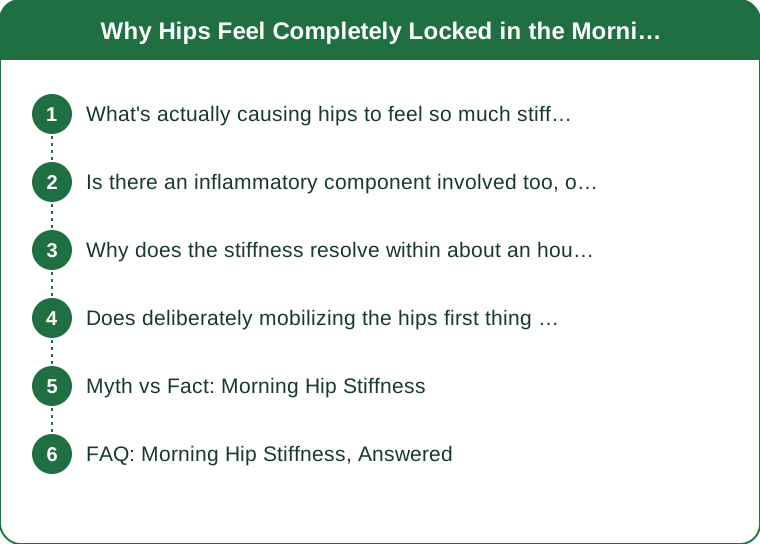
What’s actually causing hips to feel so much stiffer specifically after a night of sleep?
During prolonged stillness, synovial fluid — the joint’s natural lubricant — circulates less actively, since fluid movement within a joint depends partly on the joint actually moving through its range. Reduced circulation of this fluid over 7-8 hours of relative stillness is a major contributor to the stiff, less lubricated feeling most people notice specifically in weight-bearing joints like the hips upon waking.
Is there an inflammatory component involved too, or is it purely a fluid circulation issue?
Both play a role — mild, low-grade inflammatory markers tend to be higher in the early morning due to natural circadian rhythm patterns in cortisol and inflammatory cytokine levels, and this circadian inflammatory pattern compounds with the reduced fluid circulation to produce the specific stiffness many people notice most acutely in the first 20-30 minutes after waking. Both factors improve naturally as the body becomes more active through the morning.
Why does the stiffness resolve within about an hour rather than persisting all day?
As movement resumes — walking, standing, any morning activity — synovial fluid circulation increases relatively quickly, generally within the first 15-30 minutes of consistent movement, and the circadian inflammatory pattern that peaks around waking also naturally declines over the following hour or two. This combination is why the stiffness genuinely does resolve on a fairly predictable timeline for most people, rather than requiring any specific intervention to go away eventually.

Does deliberately mobilizing the hips first thing actually speed this process up meaningfully?
Yes — a short, gentle mobility routine within the first 10-15 minutes of waking (hip circles, gentle lunges, a few minutes of walking) accelerates synovial fluid circulation faster than simply waiting for normal daily movement to gradually resolve the stiffness. This is a genuinely useful, low-effort intervention rather than just a way to pass the time until the stiffness resolves on its own.
Myth vs Fact: Morning Hip Stiffness
Myth: Morning hip stiffness that resolves within an hour is a sign of a developing joint problem. Fact: This specific pattern — stiff on waking, resolved within roughly an hour — is a normal physiological response to overnight stillness and circadian inflammation, not typically a sign of joint pathology.
Myth: Static stretching first thing in the morning is the best way to address this stiffness. Fact: Gentle, dynamic movement (circles, easy lunges, walking) is generally more effective than static stretching for restoring synovial fluid circulation quickly after waking.
FAQ: Morning Hip Stiffness, Answered
When does morning hip stiffness become something worth discussing with a doctor rather than just normal?
Stiffness lasting significantly longer than an hour, accompanied by swelling, or that’s progressively worsening over weeks warrants a medical evaluation rather than being assumed to be this normal overnight pattern. This is general information, not medical advice.
Does age make this morning stiffness pattern more pronounced?
Somewhat, yes — reduced synovial fluid volume and slower circulation are both more common with age, which can make the morning stiffness window feel more pronounced or take slightly longer to resolve than in younger joints.
Is there anything to avoid doing first thing in the morning that could make hip stiffness worse?
Jumping straight into high-intensity movement (a fast run, heavy lifting) without any gentle warmup period is generally not advisable, since the joint hasn’t yet had the chance to restore normal fluid circulation and is more vulnerable to strain during that specific window.
TL;DR:
- Morning hip stiffness comes from reduced synovial fluid circulation and circadian inflammation patterns overnight
- Both factors resolve naturally within roughly an hour as movement resumes through the morning
- A short, gentle mobility routine within 10-15 minutes of waking speeds up this natural resolution
- Stiffness lasting well beyond an hour, or with swelling, warrants medical evaluation rather than assuming it’s normal
The locked-feeling hips at wakeup and the loose feeling an hour later are two predictable ends of the same normal overnight process — and a few minutes of gentle movement can speed up the transition between them. This is general information, not medical advice.
Keep Reading
This article is for general informational purposes only and is not medical advice. Always consult a qualified health professional for guidance specific to you.