Why Ankle Mobility Often Gets Blamed for What's Actually a Hip Restriction
Quick Answer: Limited squat depth is commonly blamed on ankle mobility, but a simple test — squatting with heels elevated versus flat — can reveal whether the real restriction is actually in the hips. If elevating your heels doesn’t meaningfully improve depth, the limitation is likely hip-related, not ankle-related.
You’ve stretched your ankles for weeks trying to squat deeper, with minimal change. The actual restriction might have never been your ankles in the first place.

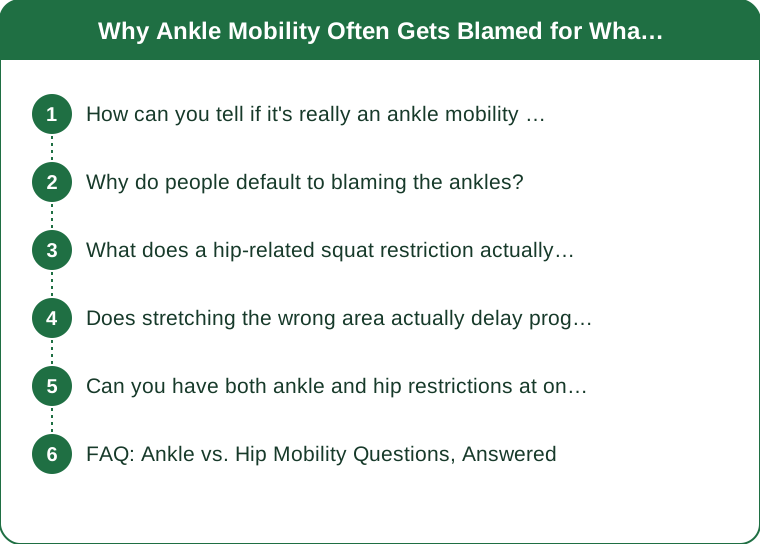
How can you tell if it’s really an ankle mobility issue?
Try squatting with your heels elevated (on small plates or a wedge) versus flat on the ground. If elevating your heels lets you squat noticeably deeper with better form, ankle dorsiflexion is likely a real limiting factor. If depth barely changes either way, the restriction is probably elsewhere — most commonly the hips.
Why do people default to blaming the ankles?
Ankle mobility is easier to test superficially (a simple wall-test lunge) and easier to conceptually understand than hip capsule restrictions, which involve more complex joint mechanics. It’s become the default explanation partly because it’s the simplest one to reach for, not necessarily the most accurate one for every individual.
What does a hip-related squat restriction actually feel like?
Often a pinching sensation at the front of the hip crease near the bottom of the squat, rather than a stretching sensation in the calves or Achilles — that pinching is a common sign of hip impingement-related restriction rather than a soft-tissue flexibility limitation that stretching alone would fix.

Does stretching the wrong area actually delay progress?
Yes, meaningfully — weeks spent stretching ankles that were never the actual limitation is time not spent on the drills (hip capsule mobilizations, controlled hip rotations) that would have addressed the real restriction. Testing before treating saves significant wasted effort.
Can you have both ankle and hip restrictions at once?
Yes, and it’s fairly common — in that case, the heel-elevated test still helps isolate how much of the limitation is ankle-driven, and addressing both areas (rather than assuming it’s purely one or the other) produces the most complete improvement.
FAQ: Ankle vs. Hip Mobility Questions, Answered
What’s a simple hip mobility test besides the heel-elevated squat?
A 90/90 hip position (seated with both legs bent at 90 degrees, one in front and one to the side) tests internal and external hip rotation, another common squat-depth limiting factor.
How long does it take to see improvement once you’re working the right area?
Once training the actual limiting joint, many people notice measurable improvement in squat depth within 4-6 weeks of consistent, targeted mobility work.
Should I still stretch my ankles even if the heel test says it’s not the limiter?
General ankle mobility still supports other movements (lunges, running mechanics), so it’s not wasted effort — just don’t expect it alone to fix a hip-driven squat depth issue.
TL;DR:
- The heel-elevated squat test helps identify whether ankle or hip mobility is the actual limiting factor
- Ankle mobility gets blamed by default partly because it’s easier to test and understand
- A pinching sensation at the hip crease points toward hip restriction, not ankle tightness
- Testing before treating saves weeks of mobility work aimed at the wrong joint
Try the heel-elevated test today — it takes 30 seconds and could redirect weeks of misdirected stretching.
Keep Reading
This article is for general informational purposes only and is not medical advice. Always consult a qualified health professional for guidance specific to you.