Mobility Training: The Missing Layer Between Stretching and Strength
You can be flexible and still move terribly — able to touch your toes yet unable to squat deep, hips that fold in yoga but ache after sitting. That gap has a name: mobility — not how far a joint can be stretched, but how much range you can actively control. Mobility training is the missing layer between stretching and strength, and ten minutes a day of it changes how everything else feels: lifting, running, sitting, aging. Here is the beginner’s map. (General fitness guidance — persistent joint pain belongs with a professional.)

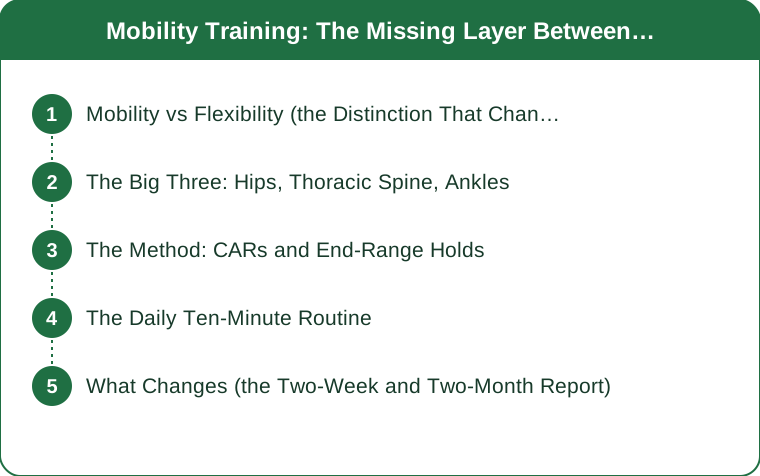
Mobility vs Flexibility (the Distinction That Changes Everything)
Flexibility is passive range — how far a joint goes when something else (gravity, a strap, momentum) takes it there. Mobility is active range — how far you can take it yourself, with control and strength at the end positions. The difference matters because life and sport happen actively: a deep squat, a reach to a high shelf, a stride up stairs all demand controlled range, not draped range. Training mobility means moving joints through their range deliberately and building strength at the edges — which is why it looks less like holding stretches and more like slow, focused movement.
The Big Three: Hips, Thoracic Spine, Ankles
Modern life attacks three areas with special dedication: hips (sitting shortens flexors and sleepy-fies rotators — the root of most squat struggles and much back grumbling), the thoracic spine (the mid-back that desk-hunching freezes, forcing neck and lower back to compensate — the hidden culprit behind both), and ankles (stiff from years in shoes — limited ankle range quietly sabotages squats, stairs and balance from the ground up). Test yourself honestly: a deep squat with heels down, a seated rotation to each side, a knee-past-toes lunge. Where it feels stuck is your syllabus.

The Method: CARs and End-Range Holds
Two tools carry most mobility training: controlled articular rotations (CARs) — slow, deliberate circles through a joint’s complete range (hip circles on all fours, arm circles standing, neck rotations), performed like you are drawing the biggest careful circle possible; and end-range work — moving to the edge of your range and gently contracting there (a deep lunge where you press the back hip forward and hold, a deep squat where you actively pry knees out). The principle beneath both: range you visit with control, regularly, becomes range you own. Range you never visit gets repossessed.
The Daily Ten-Minute Routine
The practice: 2 minutes of hip CARs (slow circles each direction, each side, on all fours), 2 minutes of deep lunge holds with gentle pulses (hip flexors, each side), 90 seconds of thoracic rotations (all-fours thread-the-needle and open-book reaches), 90 seconds of deep squat sits (supported as needed, actively prying), 2 minutes of ankle work (knee-past-toes rocks against a wall, calf-stretch pulses), and a minute of shoulder CARs to finish. Morning stiffness, pre-workout priming or evening unwinding — the slot matters less than the dailiness. Joints respond to frequency over intensity, reliably and fast.
What Changes (the Two-Week and Two-Month Report)
The timeline mobility keeps: within two weeks — mornings less creaky, squats noticeably deeper, the strange new awareness of joints as things you can feel working; by two months — strength training through fuller ranges (which builds more muscle — mobility is a lifting multiplier), running and walking smoother, desk stiffness recovering faster, and the quiet disappearance of a dozen small daily discomforts you had stopped reporting. Mobility is infrastructure: invisible when good, expensive when neglected. Ten minutes a day is the entire maintenance fee — cheaper than every alternative.
Mobility, defined and delivered: active control through range — trained with slow circles and end-range holds, ten minutes daily, hips-spine-ankles first. Run the three self-tests tonight, find your stuck spots, and start the routine tomorrow. Flexibility asks how far your body can be taken. Mobility asks how far you can go on purpose — and that question, trained daily, keeps answering better for decades.
Keep Reading
This article is for general informational purposes only and is not medical advice. Always consult a qualified health professional for guidance specific to you.