How to Tell If That Tightness Is Muscle or Nerve - and Why Stretching Only Helps One of Them
Quick Answer: Muscle tightness feels like a broad pull that eases as you hold; nerve tension feels sharper, more linear, sometimes with tingling or burning, and it often gets worse the longer you hold. The classic tell: change your neck position mid-stretch. If tucking your chin changes the sensation in your hamstring, that is neural, not muscular - the nervous system runs continuously and a muscle does not care where your head is.
Stretching a nerve like a muscle irritates it, which is why two months of daily stretching can leave you exactly where you started.
Neural tissue needs gliding, not holding.

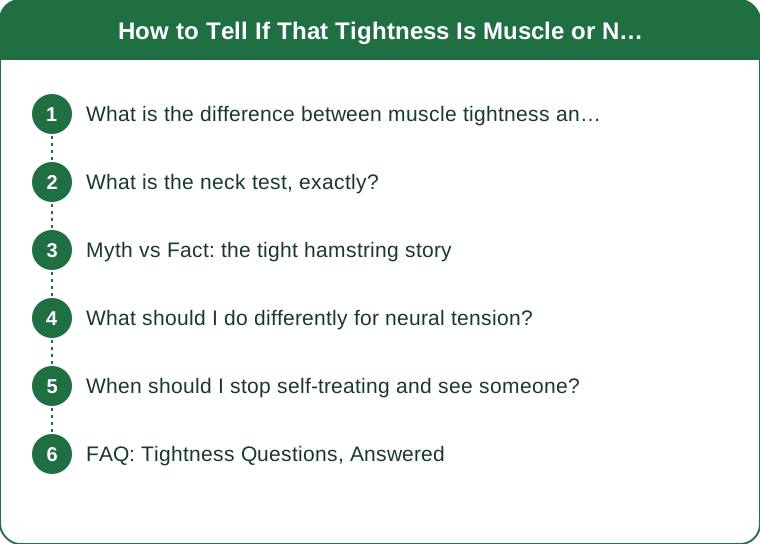
What is the difference between muscle tightness and nerve tension?
They are genuinely different tissues with different mechanical properties.
Muscle tightness is a resistance to lengthening in the muscle-tendon unit. It typically feels like a broad, diffuse pull across the muscle belly, it is fairly comfortable, and it eases within 20-30 seconds of a sustained hold. The sensation stays where the muscle is.
Neural tension is irritation or restricted gliding of a nerve within the tissue around it. It tends to feel sharper, more linear, and traceable along a path rather than across an area. It may include tingling, burning, or a distinctly unpleasant quality that people describe as ‘wrong’ rather than merely uncomfortable.
The key mechanical difference: a muscle is anchored at two ends. A nerve runs from the spine to the toes as a continuous structure, which means tension applied anywhere along it can be felt somewhere else entirely. That is what makes the neck test work.
What is the neck test, exactly?
It takes about ninety seconds and it is the most useful self-check in this whole area.
Set up: sit on the floor with one leg extended, the other bent. Fold forward into your usual hamstring stretch until you feel a clear sensation - not a painful one.
Hold that exact position. Do not move your legs or your torso at all for the rest of the test.
Now tuck your chin to your chest. Note the sensation in the hamstring.
Now look up at the ceiling. Note it again.
Interpretation: if the hamstring sensation clearly increases with the chin tuck and decreases when you look up, you are moving neural tissue, not muscle. Your hamstring length did not change - only the tension along the nerve did.
If the sensation is identical in both head positions, it is far more likely to be genuine muscular restriction, and normal stretching is appropriate.
Do the same test on both sides. A clear difference between sides is worth paying attention to.
Myth vs Fact: the tight hamstring story
Myth: A tight muscle is a short muscle. Fact: often it is not. Tightness is a sensation produced by the nervous system, and it correlates poorly with measured tissue length. Two people with identical range can report completely different tightness.
Myth: If it feels tight, stretch it harder. Fact: with neural tension, harder and longer holds tend to increase irritation. The tissue responds to gentle, repeated movement, not to sustained pull.
Myth: Tightness means weakness is not the issue. Fact: frequently the opposite. A muscle working beyond its capacity often reports as tight - and the fix is strengthening it, not lengthening it. Chronically ‘tight’ hamstrings in runners are a well-known example.
Myth: You can stretch a nerve longer. Fact: nerves do not lengthen with training. They glide within their surrounding tissue, and the goal is restoring that glide.
Myth: Morning tightness means you need more stretching. Fact: some morning stiffness is normal fluid and tissue behavior after hours of stillness, and it resolves with movement within an hour. That is not a restriction to treat.

What should I do differently for neural tension?
Nerve glides, not stretches. The principle is movement through range rather than holding at end range.
A basic sciatic nerve glide, 10-15 slow repetitions per side:
- Sit on a chair, slouched slightly, chin tucked to your chest.
- Straighten one knee to lift the foot in front of you while lifting your head to look up.
- Lower the leg while tucking the chin back down.
- Continue smoothly - it is a see-saw, tension released at one end as it is applied at the other.
Rules that matter:
- Never hold. Keep moving through the range.
- Stay in the comfortable range. Neural work should produce a mild pulling at most. If it produces the sharp or tingling sensation, you have gone too far - reduce the range.
- Little and often. Once or twice a day, 10-15 reps, is more effective than one long session.
- Expect gradual change over 2-4 weeks, not immediate release.
When should I stop self-treating and see someone?
Some of this is straightforward self-management. Some genuinely is not.
Reasonable to work on yourself: mild one-sided tightness that responds to gliding, no pain at rest, no weakness, no changes in sensation, and steady improvement over a few weeks.
Worth booking a physical therapist: symptoms unchanged after 3-4 weeks of appropriate work; tension that keeps returning within days; anything that interferes with training or sleep; symptoms in both legs.
Seek medical attention promptly: numbness, weakness, or foot drop; pain radiating below the knee with tingling; any change in bladder or bowel function; numbness in the saddle area; symptoms following a fall or injury; or severe pain that came on suddenly.
This article is general information, not medical advice. A physical therapist can distinguish these in one appointment, and identifying which tissue is involved is exactly the thing that makes months of frustrating self-treatment unnecessary.
FAQ: Tightness Questions, Answered
Can I have both at the same time?
Yes, and it is common. A muscle that has been guarding around an irritated nerve does become genuinely tight. Address the neural component first, then normal stretching usually starts to work.
How long until nerve gliding helps?
Most people notice something within 1-2 weeks and meaningful change by 4-6, done consistently and gently. If it is getting worse rather than better, stop and get it assessed.
Does foam rolling help either one?
Foam rolling can temporarily reduce the sensation of tightness in muscle, though the effect is short-lived. Rolling directly over an irritated nerve path is not helpful and can aggravate it - if rolling a spot produces tingling, that is a reason to move off it.
TL;DR:
- Muscle tightness is broad and eases with a hold. Nerve tension is sharp, linear, and often worsens.
- Use the neck test: if tucking your chin changes hamstring sensation, it is neural.
- Nerves need gliding, not stretching - 10-15 slow reps, never holding, staying comfortable.
- Chronic tightness is often a strength problem, not a length problem.
- Numbness, weakness, or symptoms below the knee mean get it assessed rather than working around it.
If you have been stretching the same thing daily for months with nothing to show for it, run the neck test tonight. Ninety seconds may explain the whole plateau. This is general information, not medical advice.
Keep Reading
This article is for general informational purposes only and is not medical advice. Always consult a qualified health professional for guidance specific to you.