How Long Does Mobility Training Actually Take to Show Results?
Quick Answer: Noticeable improvements in how a movement feels can appear within 1-2 weeks of daily mobility work, but measurable, lasting range-of-motion changes in tissue typically take 6-8 weeks of consistent practice, similar to the timeline for building strength.

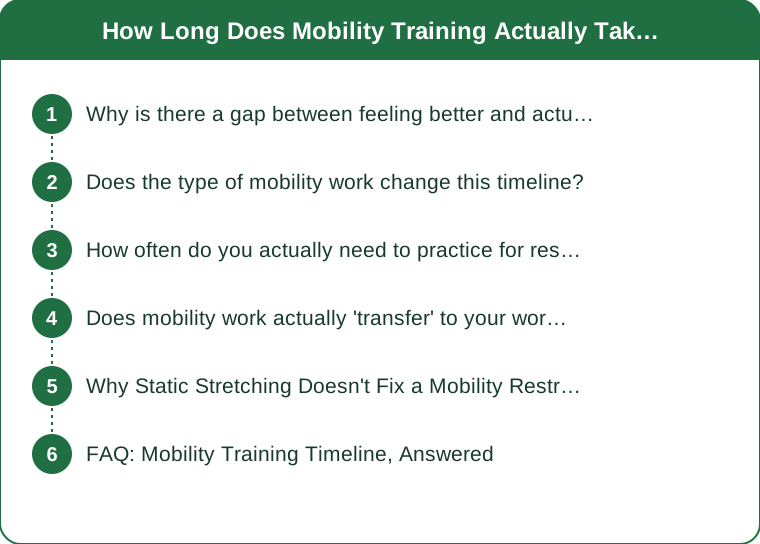
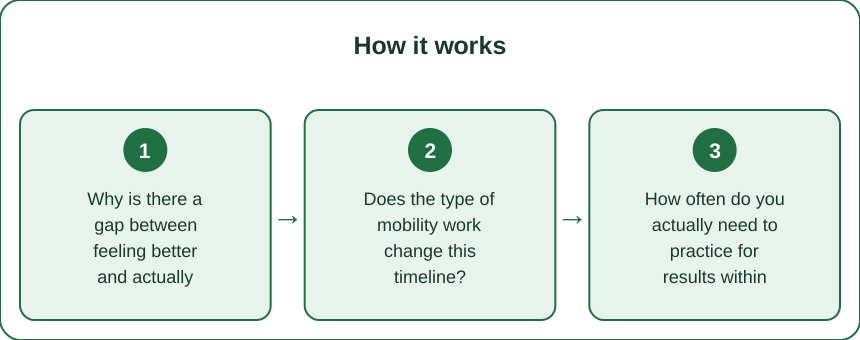
Why is there a gap between feeling better and actually measuring more range of motion?
The early improvement mostly comes from nervous system adaptation — your brain becomes less protective and allows a joint to move further because it’s learned the range is safe, not because tissue has actually lengthened. Genuine tissue-level change, which is more durable, takes longer and requires sustained, repeated practice.
Does the type of mobility work change this timeline?
Yes — dynamic mobility drills (controlled articular rotations, active stretches) tend to show nervous-system-driven improvement faster than passive static stretching alone, and combining both approaches generally produces better and more lasting results than either alone.
How often do you actually need to practice for results within that 6-8 week window?
Most research on mobility and flexibility gains suggests at least 3-5 sessions per week, even if each session is brief (5-10 minutes). Sporadic, once-a-week mobility work is unlikely to produce meaningful change within any reasonable timeframe, regardless of how long you keep it up.

Does mobility work actually ‘transfer’ to your workouts, or is it a separate skill?
This depends on specificity — mobility gained through movements similar to what you actually train (like a deep squat mobility drill for someone who squats) transfers well, while generic stretching unrelated to your training movements transfers less reliably. This is a common reason people do mobility work for months without their actual lifts or sport improving.
Why Static Stretching Doesn’t Fix a Mobility Restriction Caused by Joint Structure
Not all restricted range of motion comes from tight muscles — some comes from bony or joint-structure limitations that stretching physically cannot change, no matter how consistently it’s practiced. If months of consistent stretching produce zero improvement in a specific joint, this structural possibility is worth discussing with a physical therapist rather than assuming you’re just not stretching correctly.
FAQ: Mobility Training Timeline, Answered
Is it normal for mobility to regress if you stop practicing?
Yes — like strength, mobility gains fade without maintenance, typically noticeable within 2-3 weeks of stopping consistent practice.
Should mobility work be done before or after workouts for best long-term results?
Dynamic mobility works well as a warm-up, while more static, longer-hold mobility work is generally better placed after training or on separate days for building lasting range of motion.
Can you improve mobility too quickly in a way that’s risky?
Yes, pushing into new end ranges too aggressively before tissue and nervous system adaptation catches up can increase injury risk, which is part of why gradual, consistent practice outperforms occasional intense stretching sessions.
TL;DR:
- Early improvement (1-2 weeks) is mostly nervous system adaptation
- Lasting tissue-level change takes 6-8 weeks of consistent practice
- 3-5 sessions per week produces better results than sporadic once-a-week work
- Mobility work transfers best when it mirrors your actual training movements
If mobility work feels like it’s working within days, that’s real — it’s just the first, faster layer of a longer process.
Keep Reading
This article is for general informational purposes only and is not medical advice. Always consult a qualified health professional for guidance specific to you.