How Long Does Mobility Training Actually Take to Show Results?
Quick Answer: Noticeable subjective improvement (less stiffness, easier movement) often shows up within 2-3 weeks of consistent daily mobility work, while measurable range-of-motion changes in research studies typically appear at the 4-8 week mark with regular practice. Structural tissue changes take longer, generally months.
Mobility work gets recommended constantly, but rarely with an honest timeline attached. Here’s what the research and consistent practice actually suggest, stage by stage.

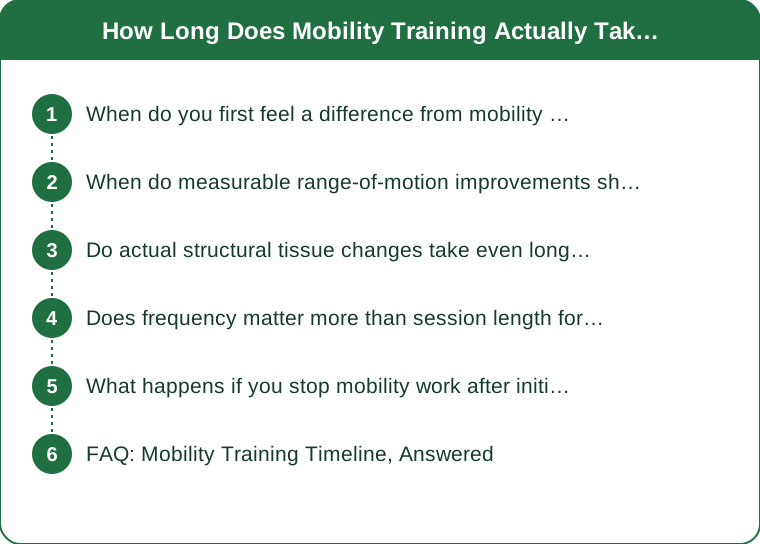
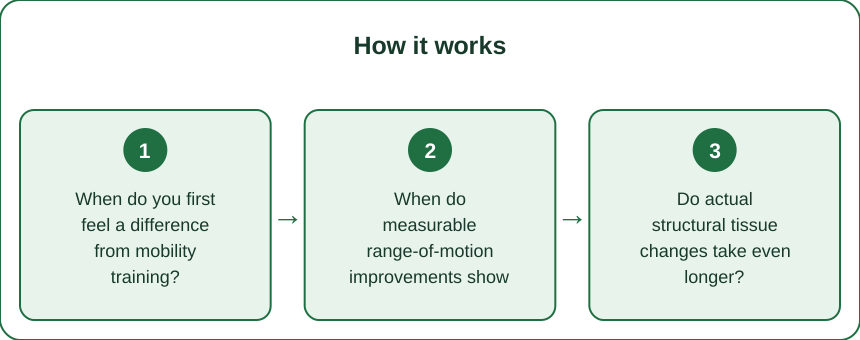
When do you first feel a difference from mobility training?
Subjective ease of movement — less morning stiffness, smoother transitions in and out of positions — is commonly reported within 2-3 weeks of consistent daily or near-daily practice. This early improvement is thought to be driven more by nervous system adaptation (reduced protective muscle tension) than actual tissue lengthening, which explains why it happens faster than the deeper structural changes.
When do measurable range-of-motion improvements show up in research?
Most controlled studies measuring actual joint range of motion (like hip flexion or ankle dorsiflexion) with consistent stretching or mobility protocols 3-5 times weekly show statistically significant improvement at the 4-8 week mark, not immediately. This is the point where the early nervous-system-driven ease starts to be joined by genuine, measurable range increases.
Do actual structural tissue changes take even longer?
Yes — connective tissue remodeling (actual changes in muscle and fascia length and elasticity) is generally understood to take months of consistent loading, not weeks, based on tissue adaptation research broadly. The practical takeaway: early gains are real but partly ‘borrowed’ from reduced tension; lasting, structural mobility improvement is a longer-term, months-long project.

Does frequency matter more than session length for mobility results?
Generally yes, based on the available research pattern — short, frequent mobility sessions (5-10 minutes daily) tend to outperform occasional longer sessions (30+ minutes once a week) for building consistent range-of-motion improvement over time, likely because frequent nervous system exposure to a stretched position matters more than total single-session duration.
What happens if you stop mobility work after initial gains?
Improvements are not permanent without maintenance — studies generally show range of motion gains regress partially within a few weeks of stopping consistent practice, back toward (though not always fully to) baseline. This mirrors general use-it-or-lose-it patterns seen across most physical adaptations, mobility included.
FAQ: Mobility Training Timeline, Answered
Is it normal to feel worse before feeling better with new mobility work?
Some initial mild soreness from unfamiliar stretched positions is common and generally resolves within the first week or two as the body adapts.
Does age affect how long mobility training takes to show results?
Older adults may see a somewhat slower timeline for measurable range-of-motion change due to naturally reduced tissue elasticity, though consistent practice still produces meaningful results at any age.
Should mobility work be done before or after workouts for best long-term results?
Both have a place — dynamic mobility work before training and longer static holds after or on separate days are both commonly recommended, and neither alone captures the full timeline benefit described here.
TL;DR:
- Subjective ease of movement often improves within 2-3 weeks of consistent practice
- Measurable range-of-motion gains in research typically appear at 4-8 weeks
- Genuine structural tissue changes take months of sustained practice
- Frequent short sessions tend to outperform occasional long ones
Mobility work rewards patience in stages — early wins are real, but the lasting change is a months-long project, not a two-week fix.
Keep Reading
This article is for general informational purposes only and is not medical advice. Always consult a qualified health professional for guidance specific to you.